Monday, February 10, 2014

Valentine's Day: Planning Perfect Date

Valentine's Day: Planning Perfect Date
by Amna, Kate, Selena and Akhanda

Valentine’s Day (AKA Single Awareness Day) is this upcoming Friday, and couples will be exchanging gifts, going out to dinner, and spending time with each other. This pseudo holiday has seen increasing consumerism in recent history; stores start putting up Valentine’s Day decorations days after New Years, and people start to feel the pressure to buy chocolate, flowers, cards, and even rings for their significant others. Valentine’s Day “craze” affects college students about as much as everybody else, including those of us in the Five College area. According to the National Retail Federation, consumers are keeping a tighter leash on their spending for Valentine’s Day. Students are bound to an even tighter budget within which the cost of the stereotypical dinner and entertainment (or gift) has to fall. A common question that people come up against is "how much should be spent on the entertainment and how much on dinner?”

Take Mary's significant other, Alex. Alex knows that Mary loves getting taken out to dinner and going to music events, and (s)he wants to make the 2014 Valentine's Day very special for her. Unfortunately, Alex is but a poor college student, and has a budget of $100. So, (s)he sets out to plan out the evening. Mary loves all musical concerts, ranging from local recitals to small concerts to big productions. In particular, Mary loves Adele. She also loves fancy restaurants and fancy champagne, but she is a foodie, and loves to try different types of food, regardless of price level. So, after some research on local restaurants and concerts, Alex decides that they will go to Thai Garden in Northampton and see a local band's concert. But after some calculation, (s)he realizes that there is still money left over, so Alex decides that instead of seeing the local recital, they could afford to see a Mumford and Sons concert* instead.

The above hypothetical scenario is descriptive of how many couples would make decisions on how to spend on Valentine's Day. Underlying Alex's decisions is the economic concept of utility maximization.
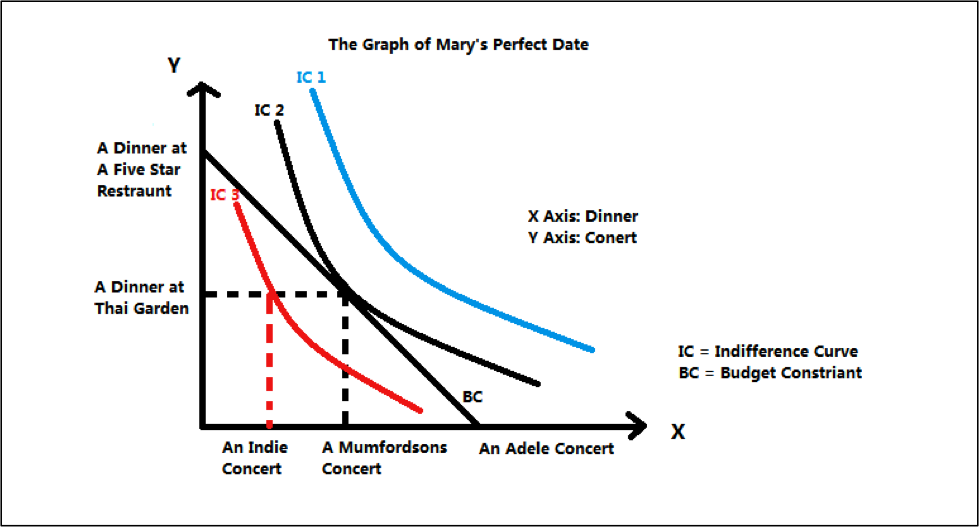


We can see that for Alex and Mary, going to Thai Garden and seeing Mumford and Sons is strictly preferred to going to Thai Garden and seeing a local band's concert. Therefore, Alex and Mary will be maximizing their utility on Valentine's evening. While most people don't think in strict economic terms when planning out a date for their significant others, but the thought process is similar, and the concept of utility maximization is quite illustrative.

* Assuming that Mumford and Sons concert is more expensive and preferable to Mary.


Monday, January 27, 2014

On Marriage...

Marginal Revolution discusses marriage and household income inequality here.

Tuesday, January 21, 2014

On Amazon and ebooks

At Cheap Talk, a preview on how game theory (we will learn later in the course) affects firm level decisions while analyzing retailer adoption of selling the kindle.

Welcome to Micro Theory, Spring 2014!

Hi everyone and welcome to the new semester! We will use this blog to direct us to stories written by famous economics bloggers as well as post the blogs written by you throughout the semester.

Thursday, December 15, 2011

Playing Game Theory for an Exam: Large Classes and Small Classes


Playing Game Theory for an Exam: Large Classes and Small Classes
Zehra, Adaora, and Anna

            For some classes at Mount Holyoke, grades are given on a curve, often so the averages is a B or B+, to reflect the average grade of all of Mount Holyoke. In Macroeconomic Theory, a grade doesn’t mean anything by itself, it only means something compared to the other students.  Since the average grade is a B+ every year, it means that every year, the number of questions needed to make a B+ changes. Some years, if almost every student gets every question right on every exam, getting one more question wrong than the class average may put a student at a B-, even though if another year, if a class wasn’t as bright, the same number of questions right on the exam may be an A. This also gives the class has control, in theory, of how what a B+ should be. If everyone in the class makes sure to do poorly on an exam, the B+ would not be only a few questions answered correctly. However, this means if one person did ignore the class’s plan and answered a few more questions correctly than the original plan, they would get an A without doing particularly well, presenting a form of Prisoner’s Dilemma, with the Nash Equilibrium of always doing well, or at least trying to do well, in an exam or paper.

            Even in small classes, a curve on an exam sometimes arises. Though the teacher may not mean to, but if everyone in a six or seven person class didn’t do well on an exam or paper, the professor may deem the topic or exam questions too hard, trusting her students to have tried their best, and add bonus points if it is an exam, or reading papers with a lower standard. Therefore, students also have the Nash Equilibrium of doing their best, no matter what the other students may have decided.   

Tuesday, December 13, 2011

The Economics of College Tuition Fees


The Economics of College Tuition Fees
Lina, Olivia, Xinyang and Yang

If you are sensitive to price changes and the money you (or your family to be more specific) spent, it’s not too hard to notice that the tuition fee of Mount Holyoke College is increasing through your staying here and that everybody’s bill has a different number on it. Why is that?

In the 2011-2012 school year, Mount Holyoke’s tuition is $41,270. Room and board cost $12,140. Including student activities fee of $186, the total amount is $53,596. ( Type in the following website address to check the latest tuition fee number: http://www.mtholyoke.edu/admission/tuition_finaid.html. ) According to an online ranker website DMVFollowers, this year Mount Holyoke ranks #66 among the top 100 most expensive colleges in U.S. (http://www.dmvfollowers.com/?p=3631) Taking into account the quality of education that has been offered here, this ranking doesn’t look too unreasonable. However, it should not prevent us from exploring the economics behind college tuition fees either.

According to the College Board, the average cost of tuition and fees (including costs for books, transportations etc.) for the 2011-2012 school year is $42,224 at private colleges, $21,447 for state residents at public colleges, and $33,973 for out-of-state residents attending public universities, while the U.S. median total household income is only $49,445. This partly explained why the amount of student loans taken out exceeded $100 billion last year.

How does economic theory explain the expensive and constantly increasing college tuitions fees?

One obvious reason could be resulted from the development of new knowledge and programs. However, William Bowen has proposed a theory in 1967 attributing the constant increase in college tuition fees to the fact that higher education institutions were not sharing in the productivity gains that applied to the rest of the economy. For example, in a college like Mount Holyoke where student vs. faculty ratio is almost fixed, faculty productivity doesn’t increase over time (because they always teach fixed number of students). While in other industries, increasing productivities push wages to go up. Therefore, if the college administrators restrict tuition growth rate to inflation rate, faculty salaries would fall behind the earnings of other professionals, which is not beneficial for colleges in the long run.

In terms of profit maximization, it’s hard to judge whether high prices are optimal for colleges because the demand curve for college admission is downward sloping. The higher the tuition fee, the fewer the people who would be willing to pay.  Thus theoretically, all colleges would eventually reach a point where increasing tuition fee causes shrinking profits.

Then what do colleges do to improve the situation and enhance their profits?

Unlike pure monopolies, colleges have a tool that doesn’t exist in most other industries: colleges can charge different prices for each individual student by granting different amount of financial aid!

In a monopolistic model without financial aid, the college can only pick one price (p_1, p_2 or p_3):
.
In the graph, revenues are areas of the rectangles.

However, if we include financial aid into the model, each one extra unit can take a different price. For example, if we just want to limit our price to be below p_1 and above p_3, we can get the whole area below p=p_1 and the demand curve, and left to q=Q_3.

Monday, December 12, 2011

PVTA Buses: To Run or Not to Run, That Is The Question!


PVTA Buses: To Run or Not to Run, That Is The Question!
by Linda, Rudmila, Alina, Taniko

Who stayed on campus during Thanksgiving break?  Not a lot of people.  Many students were able to leave campus to celebrate the holiday.  Thus, there was a huge decrease in the number of students who stayed on campus.  There were, however, students who stayed on campus to catch up on school work, complete internship application, study abroad paperwork, and even visit friends in the neighboring five colleges, such as Smith, Amherst, Hampshire, and UMass Amherst.  However, for the students who stayed on campus, how could they visit their friends at the neighboring colleges if the Pioneer Valley Transit Authority (PVTA) buses were not running?

PVTA buses run throughout the five colleges as well as the pioneer valley.  Students at the five colleges can ride on it without paying for it themselves.  PVTA buses are a public good.  They have a positive externality for college students, but have a negative externality (air pollution) for the environment.  They are non-excludable and non-rival.  For example, it is not possible to prevent anyone who has not paid, from having access to it.  Anyone who wants to ride the bus, can.  Also, just because Linda is getting onto the bus does not mean that Taniko can’t.

When thinking of running the PVTA buses, one needs to analyze the cost of doing so.  For example, the fix cost (FC) is the bus itself and the lot to house the buses when they are not running.  The variable costs (VC) are gas, employees, maintenance costs, cost of insurance, etc.  Every semester, there is a range of possible variable costs that the five colleges (Mt. Holyoke, Smith, Hampshire, Amherst, and UMass Amherst) contribute to, in return for offering the public good on campuses.  All five colleges must pay for the PVTA buses, but UMass Amherst runs it.

Depending on which time of year it is, the PVTA runs on different schedules. For instance, during J-Term and summer, the PVTA buses run less frequently, on a minimized schedule and it may only run every half an hour or every hour in order to minimize cost due to fewer students and less demand on campuses.  During spring, fall, Thanksgiving, and December break, when the PVTA buses do not run at all, there is an opportunity for extra revenue by PVTA from the few students who decide to stay on campus.

With this new opportunity for revenue, the PVTA needs to analyze the cost of providing such good during those breaks.  Before PVTA can make this decision, they need to be sure that the revenue generated from this period will be greater than the cost to run it during this period.